Mastering Terraform Architecture: A Complete Guide for DevOps
Contents
- 1 The Terraform Architecture
- 1.1 Core Components of Terraform Architecture
- 1.2 How Terraform Works: The Workflow Explained
- 1.3 Dependency Graph and Resource Management
- 1.4 Backends and Remote State Management
- 1.5 Terraform Providers: The Heart of Integration
- 1.6 Modular and Scalable Architecture
- 1.7 Case Study: Terraform in Large-Scale Cloud Management
- 1.8 Security and Governance in Terraform Architecture
- 1.9 Advantages of a Well-Designed Terraform Architecture
- 1.10 Conclusion
- 1.11 Key Takeaways
The Terraform Architecture
Terraform architecture defines how this powerful Infrastructure as Code (IaC) tool manages, provisions, and automates cloud resources in a structured and efficient manner. Developed by HashiCorp, Terraform allows DevOps engineers and IT administrators to write, plan, and apply infrastructure changes using declarative configuration files. Understanding its architecture is vital to optimizing automation workflows, improving infrastructure scalability, and maintaining a reliable cloud environment.
Core Components of Terraform Architecture
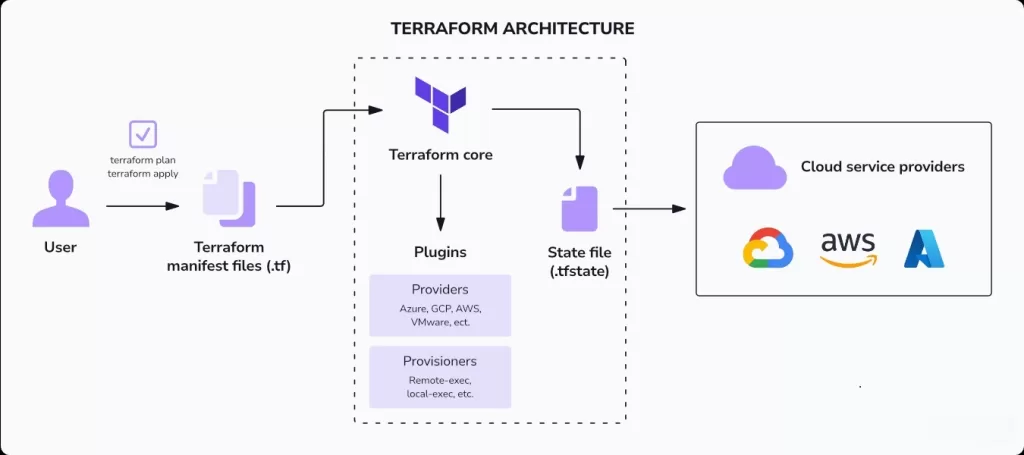
The system is built upon several core components that work together to manage infrastructure lifecycle and consistency across environments.
- Configuration Files: These are human-readable files written in HashiCorp Configuration Language (HCL) that define infrastructure resources such as virtual machines, networks, and databases.
- Terraform Core: The central part of Terraform responsible for reading configuration files, creating execution plans, and communicating with providers. It uses a dependency graph to understand the relationship between resources.
- Providers: Plugins that interact with APIs of external platforms such as AWS, Azure, Google Cloud, VMware, or Kubernetes. Providers translate Terraform configurations into actionable API calls.
- State File: A critical component that tracks the current state of the deployed infrastructure. This file ensures that Terraform can compare real-world resources with the declared configurations.
- Backend: Manages how and where the state file is stored—locally or remotely (e.g., AWS S3, Azure Blob Storage, or Terraform Cloud).
How Terraform Works: The Workflow Explained
The architecture supports a three-phase operational workflow—Write, Plan, and Apply—that ensures a predictable and version-controlled infrastructure deployment process.
- Write Phase: Users define the infrastructure in
.tffiles using HCL. For example, a simple EC2 instance configuration can be written in just a few lines of code. - Plan Phase: Terraform analyzes the current infrastructure and generates an execution plan showing what will change before any modification is made.
- Apply Phase: The tool executes the planned changes, creating, updating, or deleting resources as defined in the configuration files.
Dependency Graph and Resource Management
Terraform Core constructs a dependency graph to understand the order of resource creation. This ensures that resources depending on others—like a database that needs a network first—are provisioned in the correct sequence.
For example, when deploying an application on AWS, Terraform automatically creates networking components such as VPCs and subnets before provisioning the EC2 instances. This automation reduces manual intervention and prevents configuration drift.
Backends and Remote State Management
In team environments, sharing state is crucial. Terraform’s architecture supports remote backends to enable collaboration and secure state management. Common backend examples include:
- Amazon S3: Paired with DynamoDB for state locking and consistency.
- Azure Blob Storage: Integrates seamlessly for cloud-native deployments.
- Terraform Cloud: Offers version control, workspace management, and team collaboration features.
Using remote state storage improves reliability and prevents conflicting changes when multiple engineers work on the same infrastructure.
Terraform Providers: The Heart of Integration
Providers are the glue between Terraform and external systems. Each provider communicates with its respective API using credentials and permissions defined in configuration files. As of 2025, Terraform supports over 2,000 providers, ranging from cloud services (AWS, GCP, Azure) to SaaS platforms (Datadog, GitHub, Cloudflare).
For instance, a DevOps team can use multiple providers in one configuration to deploy a hybrid cloud setup—AWS for compute, Cloudflare for DNS, and GitHub for version control integration.
Modular and Scalable Architecture
Terraform promotes modular design through reusable code structures known as modules. A module is a collection of configurations grouped together to perform a specific function, such as creating a VPC or deploying a Kubernetes cluster.
- Reusable: Modules can be shared across projects or teams.
- Maintainable: Simplifies updates and reduces duplication.
- Scalable: Enables managing large infrastructures efficiently.
For example, a Fortune 500 company might use Terraform modules to automate multi-region infrastructure provisioning across AWS and Azure, ensuring consistency and compliance in every environment.
Case Study: Terraform in Large-Scale Cloud Management
In a 2024 survey by HashiCorp, 89% of enterprises reported using Terraform for multi-cloud management. One notable case is a global fintech company that adopted Terraform to manage over 2,000 cloud instances across AWS and Azure. By leveraging its modular architecture and remote backend, they reduced manual configuration time by 65% and improved infrastructure deployment reliability.
Security and Governance in Terraform Architecture
Security is an integral part of the architecture. Terraform supports role-based access control, encryption of state files, and integration with secret management systems like Vault. Governance tools such as Sentinel allow policy enforcement to ensure compliance with organizational standards.
- State file encryption using KMS or Vault
- IAM roles for least-privilege access
- Sentinel policies for security compliance
These features make Terraform an enterprise-ready tool for both regulated and fast-moving environments.
Advantages of a Well-Designed Terraform Architecture
- Predictable Deployments: Infrastructure changes are fully auditable.
- Cross-Platform Compatibility: Works across clouds and on-premises environments.
- Enhanced Collaboration: Teams can manage shared infrastructure using remote backends and version control.
- Automation and Speed: Reduces human errors and accelerates delivery pipelines.
Conclusion
Terraform architecture empowers teams to define, deploy, and manage infrastructure as code in a secure, scalable, and repeatable way. Its modular design, provider ecosystem, and state management system make it one of the most robust tools in modern DevOps workflows. Understanding how its components interact enables teams to optimize automation, strengthen security, and achieve cloud consistency.
By mastering Terraform’s architectural concepts, organizations can transform complex cloud environments into predictable, automated, and collaborative systems — truly embodying the future of Infrastructure as Code.
Key Takeaways
- Terraform architecture combines core, providers, state files, and backends to manage infrastructure efficiently.
- Remote backends and modularity enhance collaboration and scalability.
- Security and compliance are built-in through governance and encryption.
- Adopting Terraform architecture reduces manual work and improves deployment speed.

Related Posts
Terraform Workflow (Init, Plan, Apply, Destroy)
create aws ec2 instance using terraform

One thought on “Mastering Terraform Architecture: A Complete Guide for DevOps”
Comments are closed.